
Binance
Transforming LATAM Market Complexity into a P2P Growth Strategy
Overview
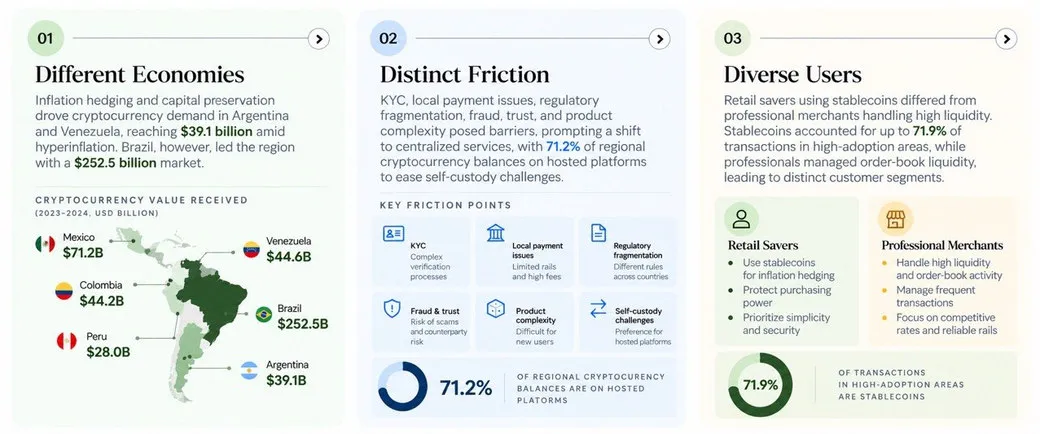
In a region processing over $730 billion in annual digital asset volume, Binance P2P held a commanding product advantage across Latin America and the Caribbean. However, sharp economic disparities ranging from Argentina and Venezuela's inflation-driven stablecoin demand to Brazil's institutional scale made a blanket regional playbook impossible.
To address this, Maksim engineered a localized Growth Marketing Framework, establishing dedicated market prioritization, localized user positioning, and custom friction-free acquisition paths that transformed regional variance into a structured growth driver.
Role
Managed the strategic work from:
- Positioning
- Market Analysis
- ICP Development
- Country Prioritisation
- Competitor Intelligence
- Customer Journey Map
- Regional Acquisition Framework
PRODUCT MARKETING MANAGER · PMM
Problem
Binance P2P possessed significant structural advantages, including global liquidity, localized payment systems, zero-fee retail trading, and escrow infrastructure. However, LATAM could not be considered a homogeneous market.
The challenge was to identify the strategic focus areas for Binance P2P, determine the key stakeholders to prioritize, ascertain the specific needs of each segment, and devise a localized positioning strategy for a global product.
Solution
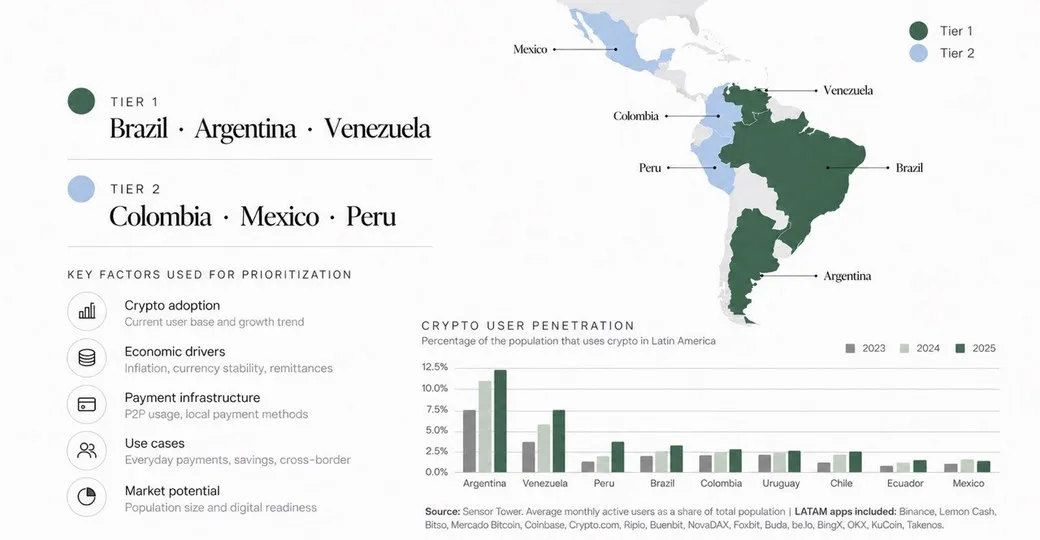
Step I: Prioritize Market Opportunities
Analyzed regional adoption, economic drivers, local payment infrastructure, peer-to-peer use cases, and market potential to transform Latin America into a prioritized expansion framework.
Step II: ICP Segmentation
Translated the broad regional demand into four distinct customer profiles,mapping their objectives, challenges, search behavior, content preferences, objections, and conversion triggers, with a concise preview of each detailed below.

Market & Segment
Juan Carlos, Mexico's Retail Taker ($1000+ Volume).
Binance P2P Core Identity
Beginner-to-intermediate user seeking a simple cash-to-stablecoin solution for regional issues.
Search Behavior & Queries
“Cómo comprar USDT en México”, “Binance P2P es seguro”, “Cómo retirar cripto a mi banco”, “Pasos para vender bitcoin en pesos”.

Market & Segment
Franco Roncero, Argentina's Retail Taker ($1000+ Volume).
Binance P2P Core Identity
An intermediate saver, primarily motivated by inflation hedging, buys USDT immediately after receiving his fiat salary.
Search Behavior & Queries
"Precio USDT Blue Argentina", "Binance P2P a Mercado Pago", "Cómo ganarle a la inflación con stablecoins", "Normativa AFIP Binance".

Market & Segment
Louis Hansen, Brazil's VIP Merchant ($30,000+ Liquidity Pool).
Binance P2P Core Identity
A seasoned entrepreneur or currency trader who advertise buying and selling in bulk using regional platforms like Pix and major Brazilian banks (e.g., Itaú, Bradesco, and Nubank).
Search Behavior & Queries
“Limites das transações P2P no Brasil”, “Arbitragem profissional de criptomoedas”, “Integração da API P2P da Binance”, “Como se tornar um comerciante verificado na Binance”.

Market & Segment
Donald Dump, Digital Nomad/Expat ($30,000+ Portfolio).
Binance P2P Core Identity
Wealthy executive or digital nomad needing secure, massive cash off-ramps to fund local lifestyles and properties in Latin America.
Search Behavior & Queries
"Move money US bank to Mexico crypto", "Secure wire to local currency LATAM", "Binance P2P English support", "Expat tax crypto Colombia".
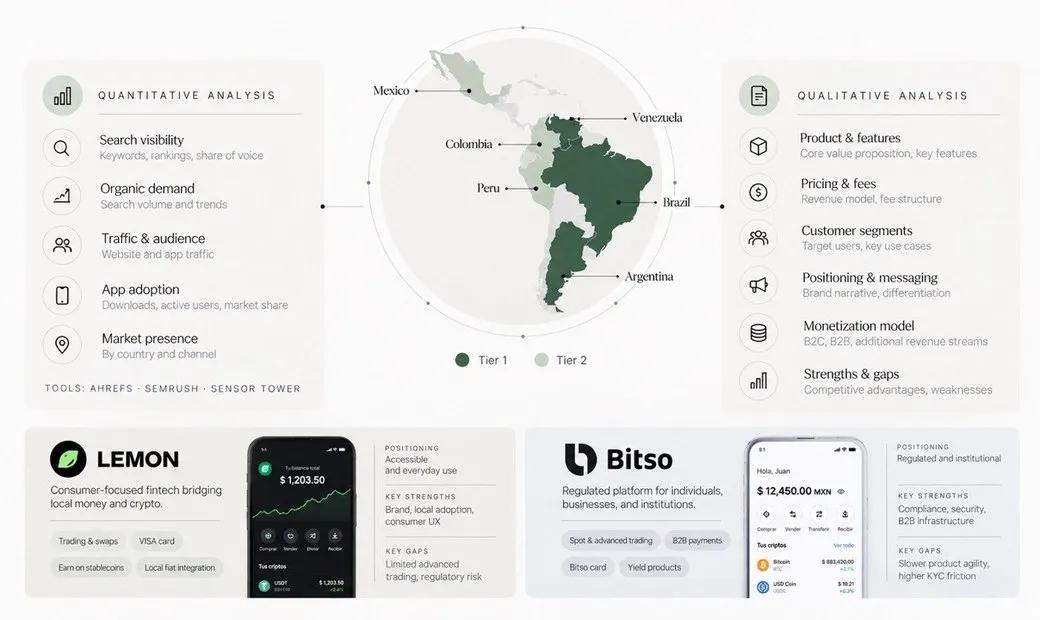
Step III: Examine the Competitive Environment
Conducted a comprehensive analysis of competitors across all six priority markets.
This analysis integrated quantitative data sourced from Ahrefs, Semrush, PageSpeed Insights, and Google Trends with qualitative analysis encompassing product, pricing, customer segments, positioning, monetization strategies, and market gaps.
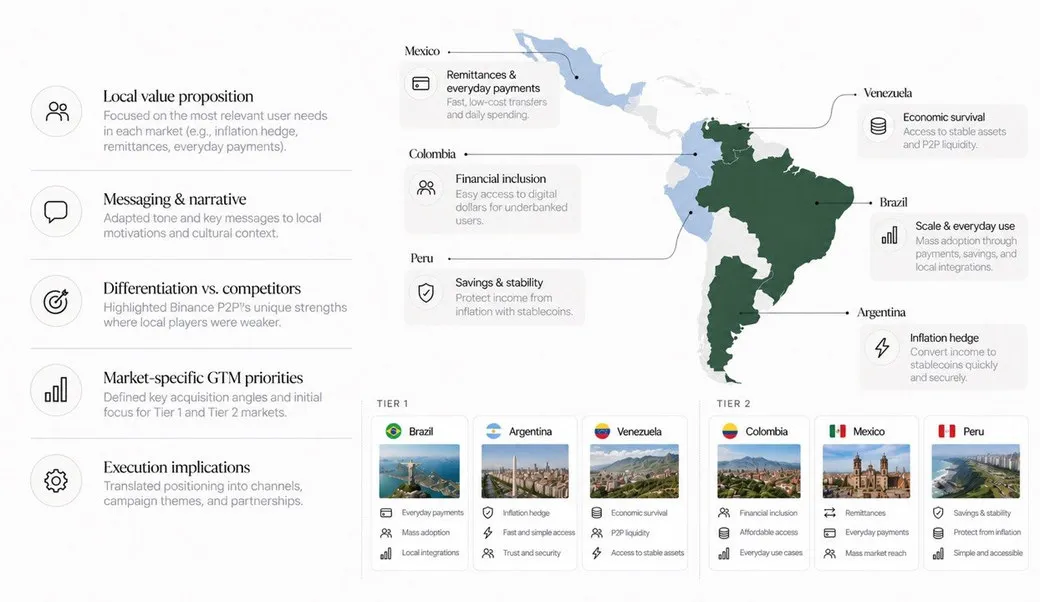
Step IV: Develop Hyper-Personalized Positioning System
Translated market insights and competitive analysis into a localized positioning strategy, customized to the economic context, user requirements, and competitive dynamics of each market.
Step V: Design the Growth Journey
The customer journey has been mapped across six distinct stages:
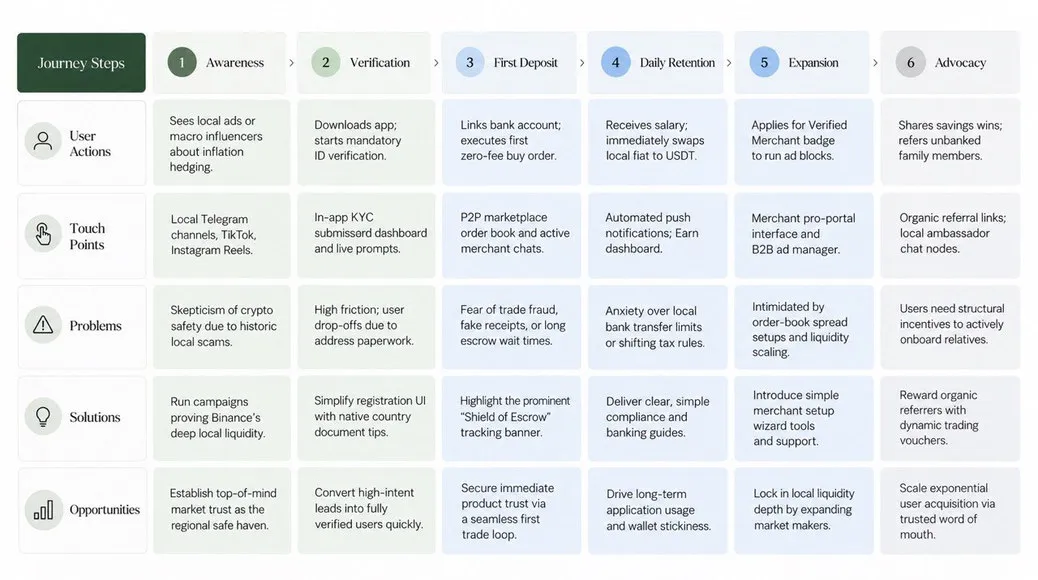
For each stage, he's connected user actions, touchpoints, friction, and growth interventions, encompassing initial education and KYC, first P2P transactions, recurring usage, merchant expansion, and referrals.
Step VI: Translate Strategy Into Execution
Finally, Maksim translated the research into a Regional Acquisition Framework, connecting Market Priorities, Positioning, Customer Journeys, Channels, Key Performance Indicators (KPIs), and Budget Allocation.
This case study illustrates selected aspects of the work. Execution-level strategy, proprietary data, and other sensitive materials are excluded under non-disclosure agreements (NDAs), however the sections above demonstrate the framework employed to transition from market intelligence to an actionable Latin America (LATAM) Growth Strategy.
*A more comprehensive version of the strategy can be shared upon request, excluding confidential and NDA-protected information.
Want the full strategy?
A more comprehensive version can be shared on request, excluding confidential and NDA-protected information.